How to Teach Cooperative Sports for Kids Beginners
Last Updated: November 4, 2026
Quick Summary
Cooperative sports for kids beginners are activities where children work toward a shared goal instead of competing against each other, with no bench, no scoreboard, and no single winner. Start with no-equipment games like Group Count-Up and Human Knot, keep groups to three to six children, and run the game as the main event rather than a warm-up.
A cooperative game has no bench, no scoreboard, and no single winner, so every child's effort counts toward the same outcome.
Group Count-Up, Human Knot, and Copy the Leader each take five to ten minutes and need zero gear.
Keep groups to three to six children for beginners so each child gets more turns and less waiting.
Rotate partners every two or three rounds so peer interaction spreads across the whole group.
Step in only when safety is at risk or when a child is being excluded, and give beginners the exact words to use.
Table of Contents
Why Cooperative Sports for Kids Beginners Beat Traditional Competition
Cooperative sports for kids beginners are activities where children work toward a shared goal instead of competing against each other, and they are the fastest way to get a nervous beginner moving. According to the Aspen Institute's Project Play participation data, 58% of U.S. youth now play organized sports, yet the children who quit earliest are usually the ones who met pressure before they met joy. Readers who want more on kids sports and confidence can browse the site's article hub.
A cooperative game has no bench, no scoreboard, and no single winner. Everyone's effort counts toward the same outcome, so a shy 5-year-old and a confident 8-year-old can play side by side without anyone feeling exposed.
Traditional leagues still have their place. But for a beginner's first season, cooperation builds the habit that competition later depends on: trust.
The Difference Between Cooperative Games and Competitive Leagues
Cooperative games are structured activities in which players combine efforts to reach one shared objective, such as moving a ball across a line as a group or keeping a balloon off the floor together.
Competitive leagues rank players and reward the top performer. Cooperative play removes the ranking and rewards the group. That shift changes everything for a beginner: fewer nerves, more touches on the ball, and far more talking.
Feature | Cooperative Games | Competitive Leagues |
Goal | Shared objective | Individual or team win |
Scoring | Group success only | Ranked results |
Pressure level | Low, beginner-friendly | Moderate to high |
Best for | First-time players, ages 3-8 | Kids ready for ranked play |
Adult role | Facilitator | Coach and official |
The Benefits of Cooperative Play for Children
The benefits of cooperative play for children go well beyond fitness. University of San Diego research on child development through sports links youth sports participation to lower stress, reduced anxiety and depression, and stronger cognitive performance.
Motor skills and coordination improve because beginners get more repetitions. In a cooperative circle game, every child touches the ball every round.
Empathy grows too. A child who helps a struggling teammate finish a relay learns to notice struggle, not just results, social-emotional learning through movement.
For more on the collaboration side, our collection of teamwork stories for kids reinforces these lessons at story time.
Cooperative Games for Kids No Equipment Needed
You do not need a gym, a ball bag, or a budget. The best cooperative games for kids with no equipment use only bodies, voices, and open space, perfect for a backyard, classroom, or park with five minutes' notice.

Three No-Equipment Games to Start This Week
Group Count-Up. The group must count to ten out loud, one number at a time, with no two people speaking at once. If two overlap, the count restarts. It teaches active listening and patience.
Human Knot. Children stand in a circle, reach across, and hold hands with two different people. The team untangles without letting go. Expect laughter and a lot of problem-solving.
Copy the Leader, Pass It On. One child starts a simple movement. The next child copies it and adds one move. The group must remember the whole sequence together.
Each game takes five to ten minutes and needs zero gear. Start with Group Count-Up for a calm entry, then move to Human Knot once the group is comfortable.
How to Teach Sportsmanship to Kids During Cooperative Play
Sportsmanship is taught in the moments between plays, not in a lecture before them, and cooperative games give you more of those moments per minute because every round produces a small conflict or a small success. Sportsmanship during cooperative play is really two skills: emotional regulation when a round falls apart, and conflict resolution when two children disagree about what went wrong.
A three-step script for in-the-moment coaching
When a round collapses, beginners need a short, repeatable sequence rather than a lecture, three steps that fit inside thirty seconds and keep the game moving.
Name the feeling without judging it. "That was frustrating when the count restarted." Naming the emotion first lowers the temperature and tells the child you saw what happened.
Ask what the group will try next. "What should we change for the next round?" The question hands ownership back to the children and turns a failure into a plan.
Praise the repair, not the result. "You asked her what she needed. That is what got the group through." The repair is the behavior you want repeated.
Let kids resolve small conflicts, and know when to step in
Step in only when safety is at risk or when a child is being excluded. For everything else, a short prompt is enough: "Tell him what you need," or "Ask her if she wants a different job." Beginners often need the exact words before they can use them, so give the sentence and let them repeat it. Adults modeling repair teaches conflict resolution faster than any rule, so apologize when you get it wrong in front of the group: "I called that too fast.
Three habits to model
Watch out: the most common mistake is treating a cooperative game as a warm-up before "real" practice. Run it as the main event for beginners, because the sportsmanship lessons only surface when the game carries real stakes for the group. Our guide on how to teach sportsmanship to young children goes deeper on the exact words to use, and the Ruff-n-Tuff Sports Pups stories give children a character who models the same repair after a mistake.
Indoor and Outdoor Cooperative Sports for Beginners
Indoor and outdoor settings solve different problems, and the choice changes how you run the game more than which game you pick. Indoor play suits rainy days, small rooms, and mixed-age groups because the space itself slows everyone down.

Indoor cooperative games for beginners
Indoor games work best when the goal is keeping something aloft or fitting into less space, because those tasks reward communication over speed.
Balloon volleyball. Teams keep a balloon airborne together and count consecutive touches. The balloon falls slowly, so beginners get time to talk, and there is no way to lose a point to the other side. Set a group target of ten touches, then fifteen, and let the children decide when to raise it.
Cooperative musical spots. When the music stops, the whole group must fit on fewer and fewer spots. The game ends when the group succeeds or chooses to stop, not when one child is eliminated. Use paper plates or masking-tape squares so the spots can shrink gradually.
Group count-up. The group counts to ten out loud, one number at a time, with no two people speaking at once. If two overlap, the count restarts. It needs no gear and teaches active listening in under five minutes.
Outdoor cooperative games for beginners
Outdoor games add distance and speed, which is where beginners most often lose confidence, so build in a rule that keeps every child touching the ball or the task.
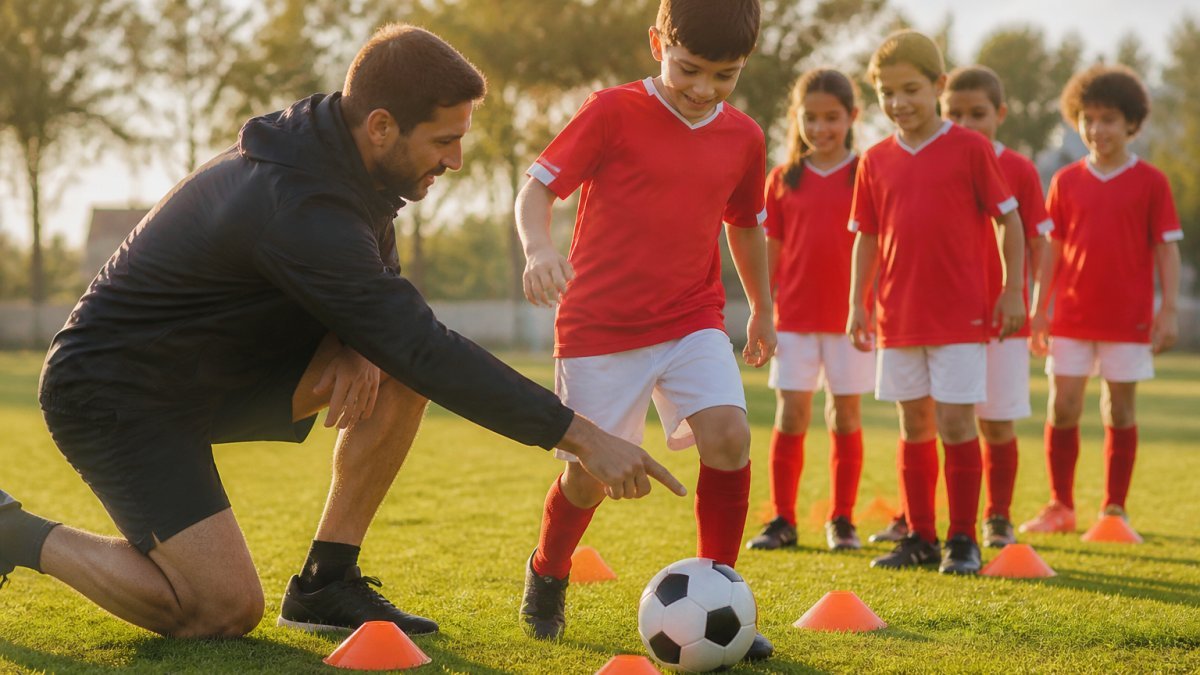
Pass-and-move soccer. A group moves a ball from one end of the field to the other with every player touching it at least once. If a player is skipped, the group restarts from the nearest cone. The restart rule matters more than the distance.
Relay puzzle runs. Split a team into pairs who complete a small task, such as sorting five colored cones or spelling a three-letter word with chalk, before tagging the next pair. Pairs rotate so no child is left with the same partner all session.
Copy the leader, pass it on. One child starts a simple movement, the next copies it and adds one move, and the group must remember the whole sequence together. Outdoors, give the group a boundary line so the sequence stays in one area.
Group size and partner rotation
Keep groups to three to six children for beginners. Smaller groups mean more turns per child and less waiting, the single biggest difference between a cooperative game that works and one that dissolves into side conversations. Rotate partners every two or three rounds so peer interaction spreads across the whole group rather than forming two cliques, a habit that builds group cohesion faster than any drill and gives a shy beginner a low-stakes way to meet every other child.
Home versus school: same games, different setup
Most cooperative game lists are written for physical education teachers, but the same games work at home or at a birthday party with three adjustments. At home, clear a space the size of two yoga mats and choose the indoor games first, because a living room rewards slow games over running games. At school or a party, set a visible boundary with cones or tape and name one adult as the facilitator whose only job is to narrate what is going well. For more on the collaboration side, our collection of teamwork stories for kids reinforces these lessons at story time, and families who want a sports-themed entry point can explore Ruff-n-Tuff Sports Pups for stories that pair with these games.
Inclusive Adaptations for Children with Disabilities
Inclusive play is not a separate program; it is a set of small adjustments. Most cooperative games can be adapted in under a minute, which is exactly why they suit mixed-ability groups.
Reduce distance or speed. Shorten the run, slow the pass, or lower the target.
Allow a partner. Pair a child with a buddy for navigation or catching support.
Change the output. A child can call the play, hold the map, or keep the count instead of running it.
The goal stays the same for everyone: the group succeeds together. Adapting the how, never the why, keeps every child inside the game.
Building Mental Toughness with MacDoodle and Cooperative Play
Mental toughness in young children is not gritting your teeth. It is the willingness to try again after a mistake, and cooperative play rehearses that skill every round.
This is where storytelling earns its place. Our article on building mental toughness in young athletes covers the practical side, and you can meet the Ruff-n-Tuff Sports Pups characters to see who your child will follow.
A simple routine works well: play one cooperative game, then read one story, then ask one question.
National Strength and Conditioning Association guidance on youth athletic development backs the broader point: multi-sport, low-pressure participation protects young athletes from overuse injuries and burnout far better than early specialization.
Beginners do not need a scoreboard. They need a squad, a story, and an adult who names what they did right.
Frequently Asked Questions
What are some simple cooperative sports for 5-year-olds?
Five-year-olds do well with games that have one shared goal and no elimination. Try a bucket-fill relay where the whole group moves water or balls from one container to another, or a parachute game where everyone lifts together to make a ball bounce. Both build turn-taking and communication skills without scoreboards. Keep rounds short, around five minutes, and praise effort over outcome. Cooperative sports for kids beginners work best when the rules fit in one sentence.
Are there cooperative games for kids no equipment needed?
Yes. Human knot, where children link hands and untangle without letting go, needs nothing but a group. Mirror mirror, where partners copy each other's movements, builds active listening and coordination. Group count, where kids count to ten without two people speaking at once, teaches patience and shared objectives. These cooperative games for kids no equipment fit indoor activities, outdoor recreation, and physical education warm-ups alike.
How do cooperative sports help with emotional intelligence?
Research on child development through sports has linked youth sports participation to lower stress. Cooperative formats add a layer: because no one loses, children practice empathy, conflict resolution, and positive reinforcement in a low-threat setting. They learn to read group dynamics and share the spotlight. Storytelling that models these moments, like the MacDoodle adventures at ruffntuffsportspups.com, reinforces the lesson between games.
How can parents encourage teamwork in beginner sports?
Praise the pass, not just the goal. Ask after practice who helped someone else, and let children solve small disputes before stepping in. Set up shared-objective games at home, such as building a pillow fort together or completing a puzzle race as one team. Variety and teamwork go hand in hand.


Comments